Is Your Website Ready for Your Next Trade Show? A Pre-Show Checklist
Published November 6, 2026
Written by: Jake Lett — Updated November 2026
Quick Answer: Every dollar you put into a trade show points at your website: the QR code on the banner, the pre-show email, the Google Ads. Buyers open it before the show to plan their route, at the booth on their phones, and after the show when they compare the shops they met. If the site looks dated, loads slowly on mobile, or has no obvious way to request a quote, it undoes the booth conversation. Finish your updates four to six weeks out: current capabilities pages, a show landing page with a short RFQ form, a tested mobile path, and lead source tracking in your CRM.
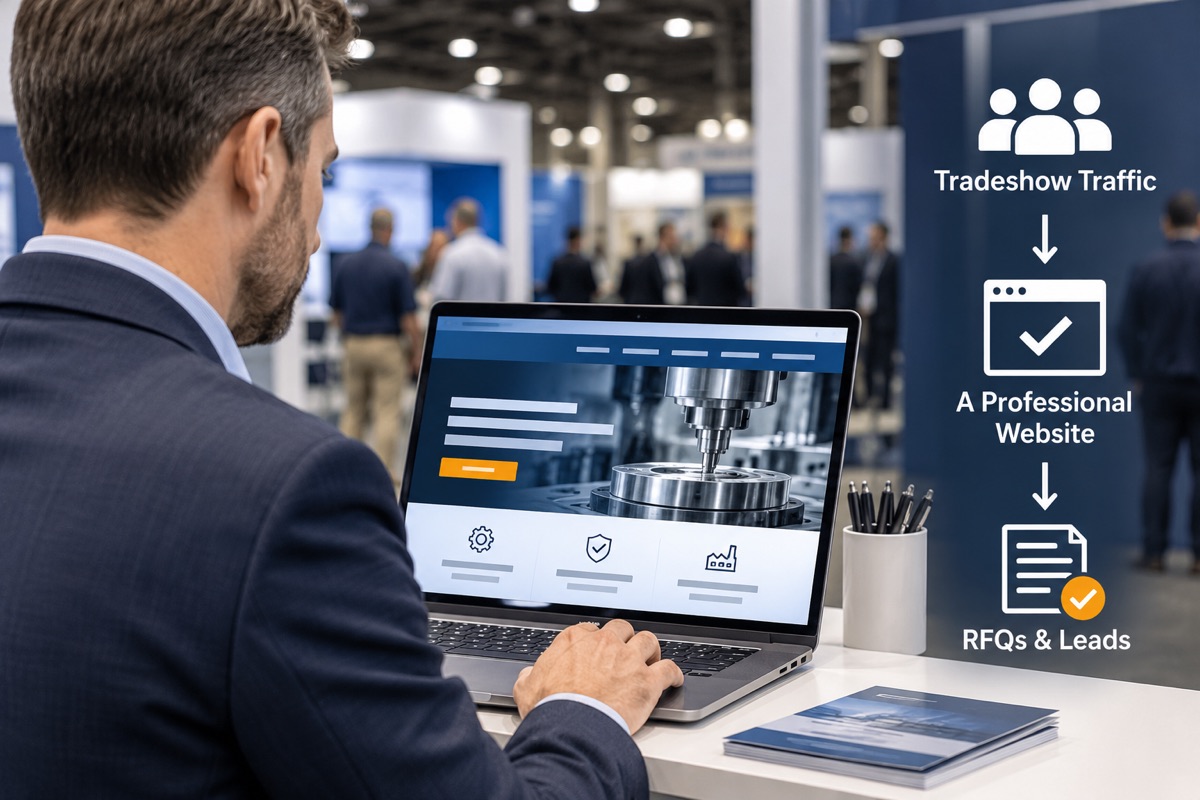
A booth, travel, and a week of staff time add up quickly. Then the banner gets a QR code, the email list gets a note, and the ads get a URL. All of it ends at the same place: your website. If that is the weak link, you are paying to send people to it.
When do buyers look at your website around a trade show?
Three times, and you are not present for any of them.
Before the show. Attendees build a list of exhibitors to visit, usually from the show directory, and click through to check each company. A site that looks abandoned gets crossed off before anyone books a flight.
At the booth. Someone scans your QR code, or looks you up on their phone while you are talking to the person next to them. They are standing in an aisle, on a convention center connection, with limited patience.
After the show. Back at a desk, the engineer has five tabs open for the shops they met and one decision to make. They are comparing sites, not booths. The booth got you into the comparison. The website decides whether you stay in it.
What does a buyer notice in the first few seconds?
Most of the damage is small and easy to avoid:
- A footer that says © 2019, or a news section whose latest item is two years old.
- Photos of equipment you no longer run, or stock images of a factory that is not yours.
- A homepage that says “precision manufacturing solutions” when the banner at your booth says “5-axis machining, parts up to 60 inches.” The buyer wanted the second sentence and cannot find it.
- A layout that needs pinching and zooming on a phone, or a quote form with a dozen required fields.
- No phone number or quote button above the fold.
You spent money to look credible in person. The website decides whether that credibility survives a look at a phone screen.
Why does a dated site waste your trade show traffic?
Traffic is the expensive part, and it is the part most manufacturers plan carefully. Conversion is the cheaper part to improve, and it usually gets the least attention.
Here is a hypothetical. You spend $3,000 on Google Ads in the weeks before a show, at about $5 a click. That buys roughly 600 visits. If 1% of them ask for a quote, you get 6 RFQs. If a clearer page and a shorter form lift that to 4%, the same spend produces 24. The ad budget did not change. Only the page did. Your own numbers will differ, but the arithmetic works the same way.
Pre-show ads work best when they target the show city and the weeks around the dates, and send people to a page built for that event. You can find the dates, city and venue for most major US shows in our free trade show finder. Each show has its own page, such as FABTECH, IMTS and The Assembly Show, with past and upcoming editions.
What does a site that turns show traffic into RFQs need?
- A landing page for each show you attend, on your own domain, with the show name, dates, booth number and what you will demonstrate or quote. Something like yourdomain.com/fabtech is easy to put on a banner and easy to remember.
- A short RFQ form: name, company, email, part description, and a file upload for drawings. Every extra required field costs you submissions.
- Capabilities pages that match the language on your booth materials, so the QR code leads to the same offer the buyer just read.
- A visible phone number and a click-to-call link on mobile.
- Pages that load quickly on a cellular connection.
- A thank-you page and form tracking, so you can count conversions and tell which source sent them.
- A CRM connection that tags the lead with the show name and notifies a person within minutes.
If your site cannot do most of this today, that is a web design problem, and it is cheaper to fix before the show than to explain a thin lead count after it. We build these for manufacturers on HubSpot, WordPress and other platforms, depending on what fits the company. Capability pages that rank on their own keep bringing in RFQs long after the show ends, which is where SEO for manufacturing comes in.
What is a good pre-show website timeline?
- Eight weeks out: audit the site. Run the RFQ scorecard and walk through the manufacturing website checklist. Make a list of stale content, weak pages and broken forms.
- Six weeks out: fix the basics. Update capabilities pages and equipment lists, replace outdated photos, remove old news, and repair anything that fails on a phone.
- Four weeks out: publish the show landing page and RFQ form, connect them to your CRM, and start Google Ads and email outreach pointing at it.
- Two weeks out: test everything. Submit the form, confirm the lead reaches the CRM and a person is notified, scan the QR code on an iPhone and an Android phone, and check load speed on mobile data.
- One week out: send QR codes and banner artwork to the printer. Confirm the printed URL matches the live page exactly.
- During the show: check new leads every day and follow up on the hottest ones the same evening.
- After the show: follow up within 48 hours. The trade show lead follow-up playbook covers the sequence.
What if the show is only two weeks away?
Do these first, in this order:
- Make sure the quote request works on a phone, start to finish.
- Remove or update anything obviously stale: old dates, old news, equipment you no longer have.
- Build one landing page for the show with a short form, and put its address on the banner.
- Add a source tag so show leads are identifiable in your CRM.
- Test the page, the form and the QR code on two different phones.
A full redesign usually takes longer than two weeks. Fix the path buyers will take now, then plan the larger project for after the show. Our FABTECH checklist covers the booth side of the same preparation.
If you are not sure where your site would lose a buyer, book a free consultation. The RFQ Growth System starts with a 30-minute call where we look at your site and your show schedule together, and tell you which fixes will make the biggest difference. If you are comparing options first, see our pricing page.
Frequently asked questions
Do I need a new website before a trade show?
Not always. Start with the pages show traffic lands on: capabilities pages, a show landing page, and your quote form. If the site is badly out of date or fails on a phone, plan a redesign, but expect it to take longer than the weeks before a show. Fix the landing path now and redesign afterward.
How far ahead of a trade show should I update my website?
Finish four to six weeks before the show. That leaves time to run ads and email with working pages, test the form and QR codes on real phones, and fix what breaks. Banners and QR codes usually need to reach the printer about a week before travel.
What should a trade show landing page include?
The show name and dates, your booth number, what you will demonstrate or quote, a way to book a time at the booth, a short RFQ form with file upload, and your phone number. Match the wording to your booth banner so the QR code shows the same offer buyers just read.
How do I track which leads came from a trade show?
Use a dedicated landing page URL with a UTM parameter for each channel (QR code, email, ads) and store the source on the contact record in your CRM. Then you can follow each lead through to an opportunity and a closed order instead of counting badge scans.
Topic: Manufacturing Website Design Solution

Written by: Jake Lett
As a marketing consultant that specializes in industrial companies, I get to see patterns and strategies to make the most impact. Manufacturers often employ a lot of people. I take pride in knowing I am helping our American economy and improving the lives of families who build things with their hands and ingenuity.
Related Posts

10 Best Manufacturing Web Design Examples
The manufacturing website design examples in this post do a great job of answering these questions. It is obvious they invested in order to clearly communicate their business value and also help inform their buyers.
Read Article

List of Manufacturing Website Design Agencies in USA
Providing an affordable web design and development service to help industrial companies & manufacturers grow their business online. Get started now.
Read Article

How Much Does a Website Design Cost for a Manufacturing Company?
Want to know how much a website design costs for a manufacturing company? This blog post breaks down the factors that affect the cost and provides tips for getting the best price.
Read Article